Perceived Quality (PQ) has always been the crucial link between engineering and customer perception. For OEMs and Tier-1 suppliers, the PQ area essentially has two main tasks:
- 1. Know the benchmark —to understand exactly which products, features, and trends are currently perceived as high-quality in the market.
- 2. Secure internal projects —to ensure that new products are designed from the outset so that perceived quality can be measured, tracked, and managed throughout the entire development process.
Both areas generate large volumes of data, evaluations, and optimization potentials. It is crucial to create transparency, set the right priorities, and make decisions based on reliable facts.
Trends shaping Perceived Quality today
In 2025, perceived quality from the customer’s perspective is about much more than flawless panel gaps:
- Sustainability and circularity Materials, carbon footprint, and recyclability are central quality attributes for many buyers.
- Software quality and HMI: Stability, user-friendliness, and updatability influence the perception of premium quality just as much as craftsmanship quality.
- Practicality & TCO: Charging speed, serviceability, and resale value are decisive factors for customers.
- Multisensory experience: Haptics, acoustics, scent, and lighting shape the first impression—and thereby influence purchasing decisions.
For PQ departments, this means that benchmark analyses must become broader, deeper, and faster. At the same time, internal projects require transparent processes that reflect and make these requirements traceable.

QTRIX as a PQ 4.0 enabler
This is precisely where QTRIX comes in: a platform that unifies car clinics, product audits, and project management in a global solution.
1. Understand the benchmark
- All market data as well as car clinic and audit results are available centrally.
- Global teams access the same central data repository—while finely graded, role-based access rights ensure that each person only sees what they are authorized to view.
2. Manage internal projects
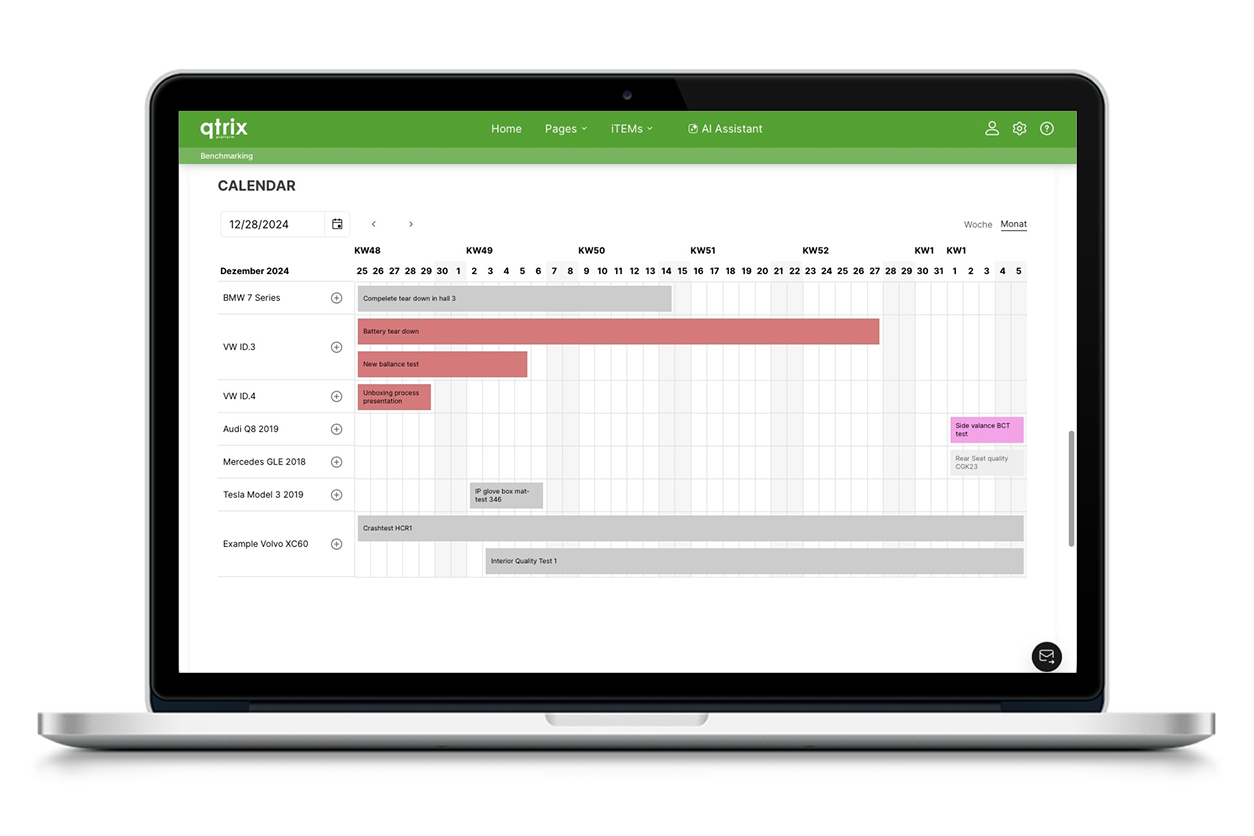
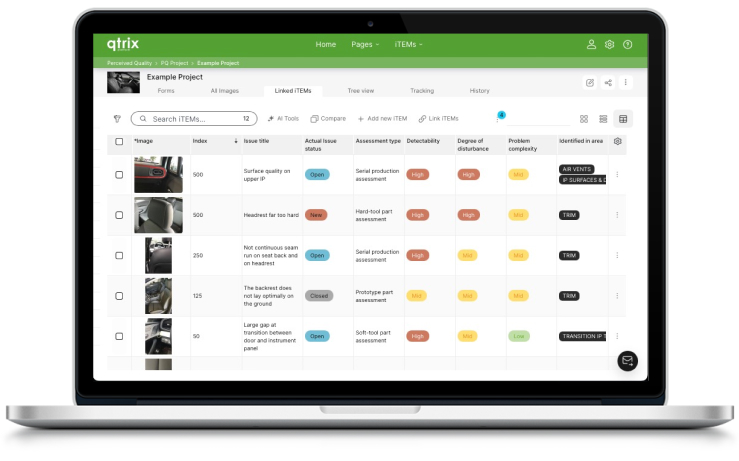
- Tracking of PQ issues Issues identified during audits are recorded, tracked, and assigned directly within the system.
- Automated workflow management Tasks are created and automatically forwarded via email to the responsible colleagues. Automatic reminders notify teams when deadlines are exceeded.
- Prioritization and transparency: Dashboards provide an at-a-glance view of which actions need to be prioritized.
- Target scores: PQ objectives can be monitored throughout the entire development process—from the concept phase to the final product—including transparent target/actual visualizations.
- Central global overview: All issues can be displayed in a central overview or filtered by project—including complete history, clear responsibilities, and transparent status tracking.
3. Intelligent support through AI
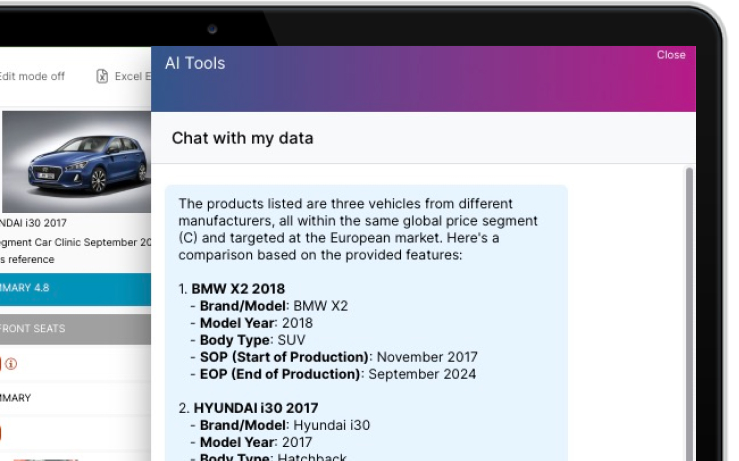
- An integrated AI chatbot assists with data analysis, uncovers hidden patterns, and provides insights that would not be apparent from raw data alone.
- This allows teams to focus on optimization—instead of spending time searching for and cleaning data.
Digital capture instead of paper – Probanden dokumentieren direkt per Tablet oder Mobiltelefon inkl. Fotos, Videos, Sprache.

Granulare Datenaufnahme– Highlights und Issues werden unmittelbar erfasst, anschließend automatisch klassifiziert (PQ-Attribute, Bauteile, Interieur-Zonen).
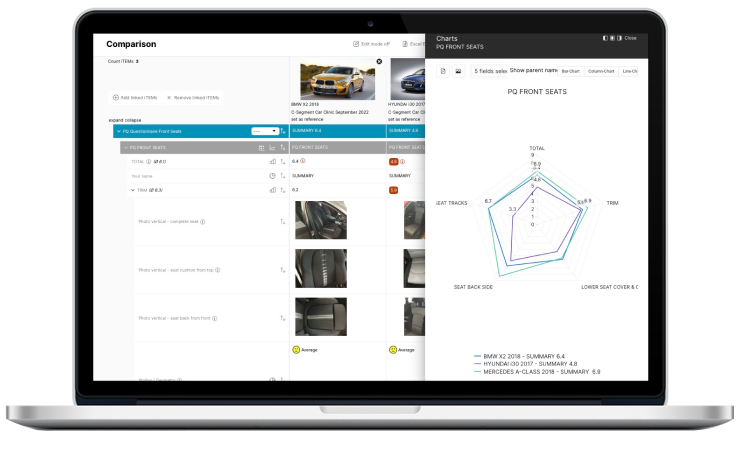
AI-supported analysis– Muster und Korrelationen werden sichtbar, Abweichungen sofort erkennbar.
Wissensmanagement– Alle Daten fließen in eine zentrale Datenbank mit Volltextsuche, Filter und Lessons Learned-Funktion.
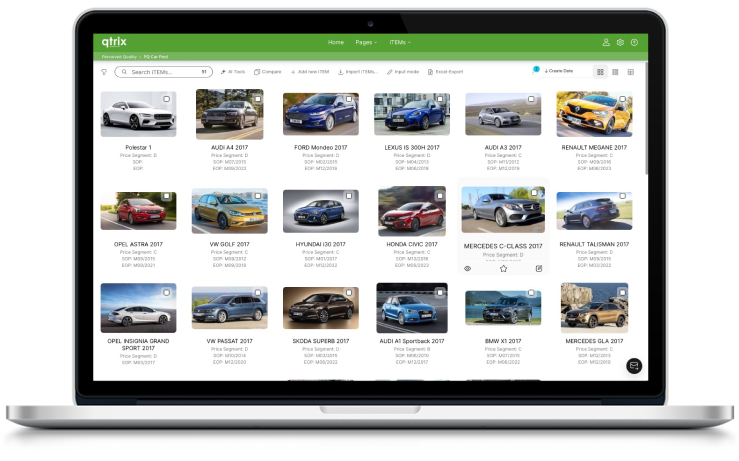
Vernetzung im Lebenszyklus– Integration von Car Clinics, Produktaudits und Kundenfeedback in Serie.
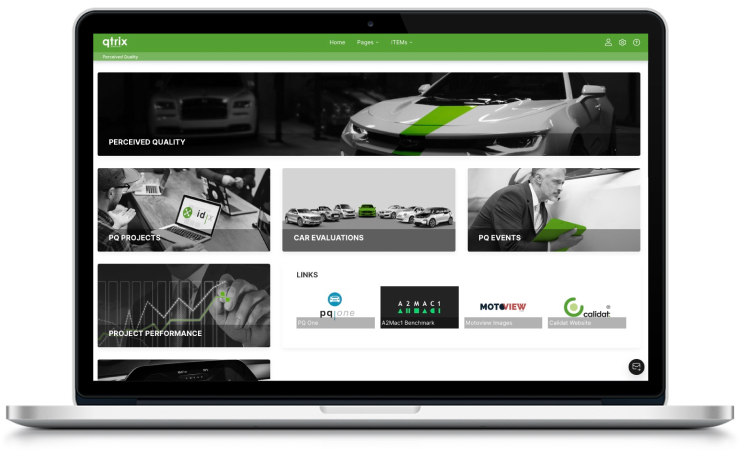
PQ-Issue-Tracking & Workflow-Management – während der Audits erkannte Issues können im System lückenlos nachverfolgt werden. Aufgaben lassen sich direkt erstellen und automatisiert per Mail an die zuständigen Kollegen weiterleiten. Individuelle Prozessphasen und Rollen können flexibel definiert werden. Alle offenen und abgeschlossenen PQ-Issues sind auf einen Blick sichtbar, Berichte lassen sich automatisiert generieren und als PPT exportieren – perfekt für Projekt-Reviews oder Management-Präsentationen.
Beispiel aus der Praxis
Stellen Sie sich vor, ein Fahrzeugaudit dokumentiert 50 PQ-Issues. Traditionell wären diese in Excel-Listen gesammelt worden – mit unklaren Verantwortlichkeiten und einem hohen Risiko falscher Priorisierung.
With QTRIX:
- Jedes Issue wird im System erfasst, automatisch einer verantwortlichen Person zugewiesen und mit einer Frist versehen.
- Alle Issues werden in die globale Datenbank integriert und sind für alle relevanten Teams sichtbar.
- Dashboards machen sichtbar, welche Issues den größten Einfluss auf den Final Product Score. haben.
- Werden Fristen überschritten, greifen automatische Erinnerungen.
- Projektverantwortliche können jederzeit einen PPT export mit dem aktuellen Status erstellen – direkt einsetzbar für Reviews oder Management-Meetings.
Fazit
Perceived Quality 4.0 bedeutet längst mehr als das Sammeln von Kundenfeedback – es geht darum, Wissen global zu steuern und in Entwicklungsprojekten wirksam umzusetzen.
With QTRIX:
- Car Clinics und Benchmark-Analysen werden schneller, transparenter und weltweit zugänglich.
- Interne Projekte werden von Anfang an über messbare Target Scores gesteuert.
- PQ-Issues verschwinden nicht länger in Tabellen, sondern werden nahtlos bis zur Lösung nachverfolgt.
- KI-gestützte Insights helfen dabei, Trends frühzeitig zu erkennen und Entscheidungen gezielt in die richtige Richtung zu lenken.
Damit wird QTRIX zur Grundlage für PQ-Abteilungen weltweit, effizienter zu arbeiten – und schafft Freiraum für das, was wirklich zählt: die Optimierung und kontinuierliche Verbesserung der wahrgenommenen Produktqualität.